
Modern-day colonialism is enabling Trump's deep-sea mining ambitions in the Pacific
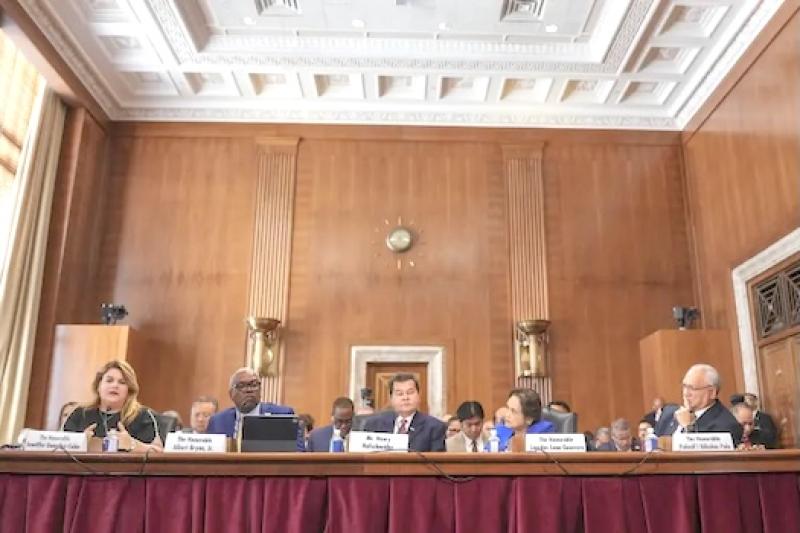
Pago Pago, AMERICAN SAMOA — Lou Leon Guerrero, the governor of Guam, learned about the government’s plan to mine her people’s waters the same way everyone else did: by reading the news.
It was November 12, and her advisor had sent her an article link — apparently, a journalist had inquired about it. She opened the page, and was stunned by what she read. The Trump administration planned to lease millions of acres of seafloor around the island to mining companies.
“I’ll never forget the date,” Leon Guerrero said from her office overlooking Agaña Bay. “I had not heard anything about it.”
She immediately called David Apatang, the governor of the Commonwealth of the Northern Mariana Islands, a neighboring U.S. territory.
“We were both very upset that we didn’t get any kind of warning,” she said. Shortly after, she rang Bill Hague, an official in the Department of the Interior, an agency that handles federal relations with territorial leaders and tribal nations.
“I know we are a U.S. territory,” Leon Guerrero recalls saying to him. “I know that you as the federal government can just come in and say, ‘I don’t care about what you guys say. We’re going to do it anyway.’” But still, she said, “I want you to know I don’t support this.” Hague reassured her, she said, that mining would never proceed without the community’s support.
Nearly a year later, that’s exactly what’s happening.
The Trump administration is moving forward with plans to lease vast swaths of seafloor to mining companies. It is part of a broader push to secure critical minerals and counter China, which dominates the global supply. These resources — including copper, manganese, nickel, and rare earth elements — are essential to military technologies and batteries.
First up are America’s Pacific island territories. In July, the Marine Minerals Administration said that it would auction access to 31 million acres of the continental shelf around American Samoa in mid-November. A month later, the agency announced plans to do the same in December across more than 67 million acres on either side of the Marianas archipelago, which includes the Commonwealth of the Northern Mariana Islands and Guam. About half of those acres border a national marine monument established by President George W. Bush.
Local leaders and environmentalists staunchly oppose these plans. Recently, Earthjustice, an environmental law nonprofit, filed lawsuits against the Trump administration on behalf of conservation groups in American Samoa and the Mariana Islands, arguing that the government does not yet know if seabed mining would harm animals that are protected by the Endangered Species Act, like whales and sea turtles.
The Marine Minerals Administration declined to comment on the ongoing litigation. Brent Lawrence, a spokesperson who responded to Grist’s questions, said that the department would continue “to closely coordinate with territorial leadership” as well as community members in American Samoa, Guam, and the Mariana Islands.
Unlike neighboring Pacific nations, which can decide for themselves whether to allow mining, Guam, American Samoa, and the Northern Mariana Islands are subject to federal decisions often made without their approval. Under international law, the Indigenous peoples of these islands have the right to free, prior, and informed consent to projects affecting their lands and waters. The Trump administration, however, says it has the authority to proceed under U.S. law.
That decision is the latest example of how the United States has for more than a century denied the residents of these islands a meaningful voice in decisions that affect them, said Adi Martínez-Román, co-director of Right to Democracy. They cannot vote for president, have no voting representation in Congress, and their right to self-determination is generally ignored, she said.
“The territories are practically invisible to the general U.S. society and to public officials,” said Martínez-Román. “It is an insidious result of the colonial framework.”