
“Stand with the Moana” demonstration calls on feds to listen to Samoan voices
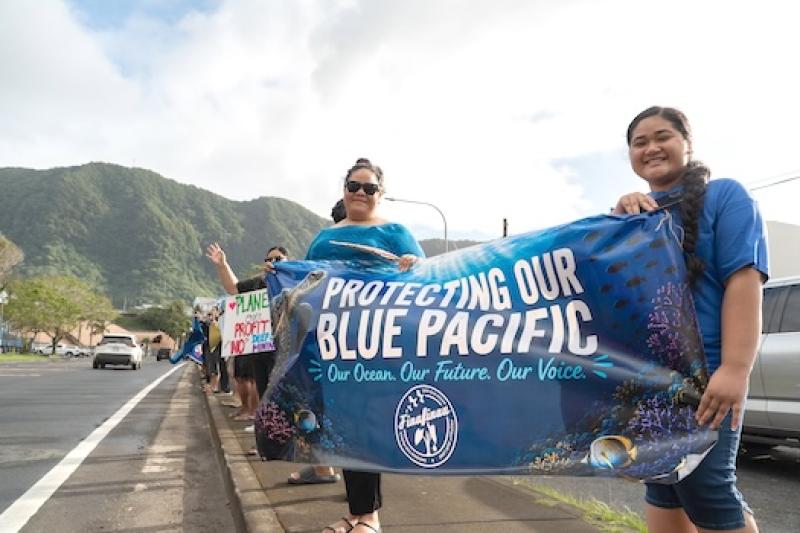
Pago Pago, AMERICAN SAMOA — A different approach to expressing strong opposition to deep‑sea mining in American Samoa’s waters took shape along the Utulei shoreline last Thursday, where youth, elders, educators, conservation advocates, government employees, fishermen, families, and community leaders gathered in a unified demonstration of respect for the ocean and shared concern over proposed federal deep-sea mining leases.
The demonstration, called “Stand with the Moana” (Stand with the Ocean), was organized by Finafinau, a nonprofit organization dedicated to cultivating leadership — especially among youth — in environmental advocacy, conservation, and community resilience.
Attended by nearly 80 community members, Stand with the Moana was intentionally designed as a peaceful demonstration rooted in Pacific values, rather than a rally centered on speeches or politics. Participants gathered along the Utulei shoreline dressed in blue, offered flowers to the ocean, observed a moment of silence, and reflected on the moana’s role as a source of life, culture, identity, and the wellbeing of future generations.
According to Dr. Sabrina Suluai‑Mahuka, Executive Director of Finafinau, the demonstration brought together many different parts of the community.
Of the participants who signed in, 22 were youth under 18, showing that young people are playing an important role in discussions about caring for the ocean. People from government offices, schools, environmental groups, community organizations, local businesses, Indigenous advocates, and local residents all took part, reflecting wide support for the event.
Dr. Suluai‑Mahuka said the event was held on Manu‘a Flag Day to honor Manu‘a, since any harm from deep‑sea mining would likely affect Manu‘a first. She also explained that Stand with the Moana was organized because the federal government has not listened to Indigenous Samoan voices and is moving too quickly with its plan to lease offshore areas for deep‑sea mining.
She emphasized that the gathering was not a protest against technology or innovation. Instead, it was meant to show Pacific values of caring for the ocean and to affirm that Indigenous communities should have a real say in decisions about their ancestral waters.
Unlike many public demonstrations, Stand with the Moana did not include many speeches. Dr. Suluai‑Mahuka gave a short welcome, shared a brief reflection on the cultural importance of the ocean, and invited everyone to pause for a moment before placing flowers into the sea. The event ended with time for conversation, media interviews, and group photos.
"The purpose wasn't to convince people through a microphone," Suluai-Mahuka said. "It was to create a space where people could reconnect with why this ocean matters in the first place."
When asked if the American Samoa Government should do more to inform people about deep‑sea mining, she said awareness alone isn’t enough. The issue needs real, meaningful involvement from the public — not just messages or announcements.
She said the government has a chance to show real leadership by setting up an open, community‑focused process that keeps people informed as the federal leasing moves ahead.
"This is a generational decision," Dr. Suluai‑Mahuka said. "It shouldn't be limited to a handful of people having ‘a seat at the table’. The people of American Samoa deserve to have their voices heard too.
"People shouldn't have to piece together information from federal websites or social media to understand what's happening in our own waters," she said. "The community deserves regular public briefings on where BOEM is in the process, what decisions are coming next, and what opportunities exist for public input."
Suluai‑Mahuka said the public should be able to see and discuss any proposed lease conditions before anything is finalized.
If there are proposed conditions attached to a lease, the people should know what those are. Those documents shouldn't only be discussed behind closed doors. They should be presented publicly, explained in plain language, and open to community feedback."
She also said public education must give people the full picture.
"If public funds are being used for outreach, that outreach should help people understand both the potential benefits and the documented risks of deep-sea mining. An informed community is one that has access to all the facts and it should be cited facts, not half truths or watered down information."
In the end, Dr. Suluai‑Mahuka said the government’s job isn’t just to join federal discussions, but to make sure the community is informed and genuinely involved.
"Our elected leaders don't just have a responsibility to sit at the table," she said. "They have a responsibility to bring the people with them. Decisions that could affect our ocean for generations should never be made without the people who will live with those consequences."
Reflecting on the demonstration, organizers said what mattered most wasn’t how many people showed up, but the wide range of community members who chose to stand together.
"We saw children standing beside elders, government employees beside nonprofit leaders, fishermen beside teachers," said Uisaina Collins, a Finafinau board member and Stand with the Moana organizer. "Many people came simply because they love the ocean. That reminded us this conversation is bigger than politics. It's about the place we all call home."
She also pointed out how meaningful the international support was throughout the day, with people sharing photos and messages from beaches, coastlines, rivers, and communities across the Pacific and beyond.
"American Samoa may be geographically small, but this demonstrates that we are not standing alone," she said. "Communities across Oceania and Indigenous nations around the world understand that the health of the ocean is a shared responsibility."
As the federal leasing process moves forward, organizers say Stand with the Moana is just one part of a much longer community conversation.
"Our hope has never been simply to oppose something," Suluai-Mahuka said. "We stand today because our children do not deserve an apology. They deserve an inheritance. An ocean that is still alive. A culture that is still thriving. And a generation that chose to protect both.
The deep‑sea mining controversy began with the Federal Executive Order expanding federal authority to accelerate domestic mineral supply chains, including seabed minerals, and instructed agencies to identify potential offshore areas for exploration. This is the policy foundation BOEM used when it began evaluating Pacific federal waters — including those around American Samoa — for possible deep‑sea mining leases.
"In just a few months, we've gone from an Executive Order directing agencies to expedite offshore critical mineral development to a proposed leasing process that could determine the future of our ocean for decades," said Dr. Sabrina Suluai-Mahuka. "Last Thursday's Stand with the Moana demonstration was an opportunity for our community to pause, gather peacefully, and remind ourselves and decision-makers that before this ocean is viewed as a resource, it is our home."
She emphasized that the event welcomed anyone regardless of political affiliation or organizational membership. A demonstration grounded in reflection.
On May 20, 2025, the U.S. Department of the Interior announced it was initiating an evaluation for a potential offshore mineral lease sale near American Samoa — the first such action in more than 30 years.
This announcement triggered BOEM’s subsequent notices and ultimately led to the territory’s town hall meeting in July last year. The majority of speakers voiced strong opposition to any exploration or extraction of minerals from the ocean floor in waters near American Samoa. Concerns ranged from environmental risks to the potential disruption of cultural and marine ecosystems.
Several individuals and local groups and organizations have voiced their strong opposition to the proposed deep-sea mining project.
Local and national environmental groups have voiced disappointment that the Trump Administration is moving forward with plans to open federal waters near American Samoa to deep‑sea mining.
On Friday, BOEM released a proposed notice outlining two 20‑year leases for mineral extraction on portions of the Pacific Ocean floor. Each lease area carries a minimum bid of $3 million.
"We must reject the false narrative that deep-sea mining is inevitable or that financial royalties are worth sacrificing our future," said Dr. Sabrina Suluai-Mahuka.
“We are talking about permanent, generational consequences to our ocean and our cultural heritage. Our elected officials have immense power to stop this, and we demand they use it immediately. Also, folks need to understand that this idea of national security is also a false narrative. They need to check out verified reports like Deep Deception which has hundreds of citations to combat this fallacy”.
Dr. Suluai Mahuka said the Governor has the explicit authority to reject rushed timelines and demand comprehensive, multi-year ecological impact data before any lease proceeds.
GOVERNMENT STATEMENT
In a statement issued Friday, Governor Pulaali‘i Nikolao Pula acknowledged BOEM's release of the proposed deep‑sea mining lease sale in federal waters near American Samoa.
The Governor noted that the Department of the Interior (DOI) and BOEM have maintained steady, transparent communication with the American Samoa Government (ASG) throughout the process, including timely updates on the Proposed Lease Notice.
“This is an opportunity for our community to provide informed input,” Governor Pulaali’i added. “Should BOEM ultimately decide to move forward with a lease sale, I remain steadfast in my position that any such development must be fully transparent, responsible, science-based, and carefully managed to protect our environment, safeguard our vital tuna fisheries and cultural heritage, and deliver meaningful, tangible benefits for the people of American Samoa.”
CONGRESSWOMAN AMATA
In a statement issued Friday, Congresswoman Uifa’atali Amata reaffirmed her opposition to seabed mining in waters near American Samoa. She emphasized that her stance has remained consistent and unchanged, despite recent assumptions or characterizations suggesting otherwise.
Uifa’atali also made clear that no one speaks on her behalf regarding this issue — not Republicans, not Democrats, and not any outside groups. Her position, she said, is her own and has been firmly maintained.
“This is my seventh public statement on this issue, because of its importance, and because various posts, comments, or statements sometimes say they describe my position – they do not. I was clear from the beginning, first that I stand with the people and then with further statements of opposition as we learned more. I submitted opposition comments to the Interior Department, and in the congressional record speaking out at congressional committee hearings. I remain opposed and consistent,” said Congresswoman Uifaatali Amata.
36TH GENERAL ASSEMBLY OF THE CCCAS
At the opening of the 36th General Assembly of the Congregational Christian Church of American Samoa this week, the keynote speaker urged the church to take a clear and courageous stand against deep‑sea mining.
Addressing more than 600 delegates and church members packed into the Ua Taunuu Church at Kanana‑fou on Monday morning, Rev. Dr. Upolu Luma Vaai — Vice Chancellor and Professor of Theology & Ethics at Pasifika Communities University in Suva, Fiji — said there are still far too many unanswered questions surrounding proposals to explore and extract minerals from waters near American Samoa.
He said it is both timely and appropriate for the church to speak out, emphasizing its responsibility to safeguard the ocean, the environment, and future generations.
His keynote paper, delivered in Samoan, drew directly from the General Assembly’s theme, “God Takes Residence in Creation,” emphasizing the theological and ethical imperative to protect the natural world.