
Senate concerned whether top Executive Branch officials are following the law
Pago Pago, AMERICA SAMOA — The preliminary report issued by the Senate Standing Committee on Government Operations about the administration's handling of the controversial $10.1 million investment of American Rescue Plan Act (ARPA) interest earnings highlights major concerns of the Legislature Branch that the Executive Branch is not following the law — thereby abrogating their leadership responsibilities.
This is further highlighted when during the press conference Governor Pulaalii Nikolao Pula held last week, Wednesday, October 14, 2026, he appealed to the people of American Samoa to remain patient as efforts continue to finalize the controversial $10.1 million investment funded by interest earnings from ARPA. He seemed to indicate that the Fono got it wrong, because they asked the wrong people.
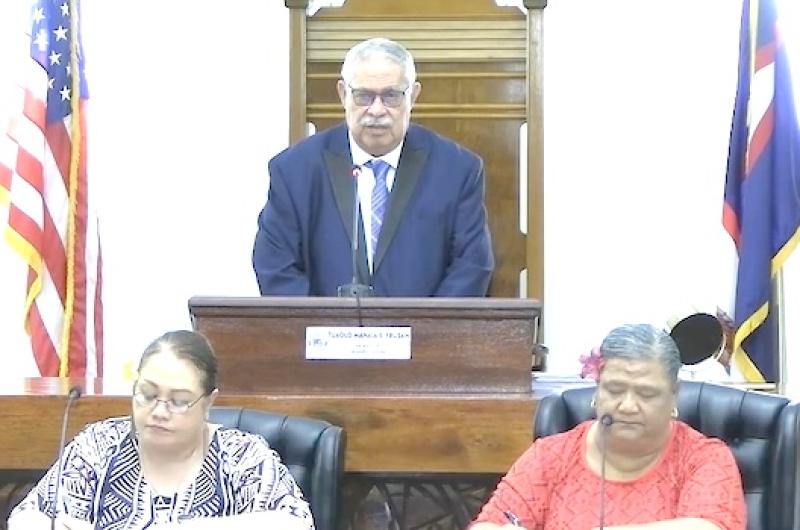
The preliminary report, which was formally presented to Senate President Tuaolo Manaia Fruean on September 8, summarizes the committee's findings following a series of hearings into the investment transaction and related financial decisions made by the executive branch.
According to the committee, testimony and evidence gathered during the investigation revealed issues extending beyond the $10.1 million investment itself, including what appeared to be a pattern of spending ARPA interest funds without obtaining the required appropriation from the Fono.
SENATE IDENTIFIES ITS CONCERNS
The committee's FIRST major concern centers on evidence indicating that the executive branch had previously withdrawn and spent more than $5 million from the ARPA interest account before the $10.1 million investment was undertaken.
Committee members stated that these expenditures were made without legislative appropriation, raising concerns about compliance with the Revised Constitution of American Samoa and territorial laws governing public finances.
The report states that the administration's actions demonstrate a willingness to bypass established legal and constitutional requirements governing the use of public funds. Senators expressed alarm over what they described as a pattern of spending money that had not been formally appropriated by the Legislature.
A SECOND concern highlighted by the committee involves the Governor's decision-making process leading up to the investment.
The report questions why the Governor did not seek or follow formal advice from Attorney General Gwen Tauiliili-Langkilde and Chief Procurement Officer (CPO) Kenneth Kuaea before committing such a substantial amount of government money to an investment opportunity that carried significant financial risk.
Senators noted that testimony presented during the hearings showed both offices had important responsibilities relating to legal review and procurement requirements. The committee said it was troubled by what appeared to be a lack of reliance on key government professionals whose expertise could have helped evaluate the proposed transaction.
Committee members further expressed concern about what they characterized as a breakdown in trust and communication between the executive branch and senior government officials tasked with protecting the interests of the American Samoa Government.
The committee's THIRD major concern focuses on the execution of the investment contract itself.
According to the report, despite laws that place procurement authority under the Chief Procurement Officer, Governor Pulaali'i allegedly directed Executive Advisor on Finance Brett Butler to sign the agreement related to the investment.
The committee noted that Butler served as an advisor to the Governor under a contractual arrangement and was not a formally appointed government official with contracting authority.
Senators questioned the legality and propriety of having an advisor execute an agreement involving millions of dollars in public funds, describing the situation as troubling and indicative of weaknesses in governmental oversight and adherence to established procedures.
In response to its findings, the committee is urging the Senate to support several measures aimed at preventing similar incidents in the future and ensuring accountability.
A final report is suppose to be released by the end of this month.
SEPARATION OF POWERS IN GOVERNANCE
The Fono has long been at odds with the Pula Administration over what it perceives as the administration’s interpretation of the law, such as directors of departments need to be confirmed by the Fono.
Last year in October, Governor Pulaali’i wrote a letter to the Senate President stating his belief in the separation of powers in governance.
He stated that the Executive powers granted him under the American Samoa Revised Constitution gives him the authority to manage personnel and execute the laws; while the constitutional Legislative powers granted to the Fono are to enact laws, which while including appropriation of budgeted sums based on revenue projections, it does not include personnel decisions for the Executive Branch of government. That power lies with the Governor.
“The deliberate reduction of personnel budgets in specific departments, seemingly based solely on the Fono's disagreement with a department leader's salary, title, or its belief that the director is subject to legislative confirmation, constitutes an overreach of legislative authority and violates the separation of powers guaranteed under the Revised Constitution of American Samoa.”
The Fono had eliminated the proposed budgeted salaries of those directors it said had not been brought to the Fono to be confirmed.
It now remains to be seen, if the governor’s belief of separation of powers in governance also applies to using ARPA interest money without Fono appropriation.
[Rhonda Annesley, Samoa News editor contributed to this report ]